
Since 15 July 2026 the border between Spain and Gibraltar has been open and passport control lifted. Even so, a trip into Gibraltar from Spain in a hire car still counts as leaving the country, so cross-border rates from the car hire companies apply.
What changed on 15 July 2026
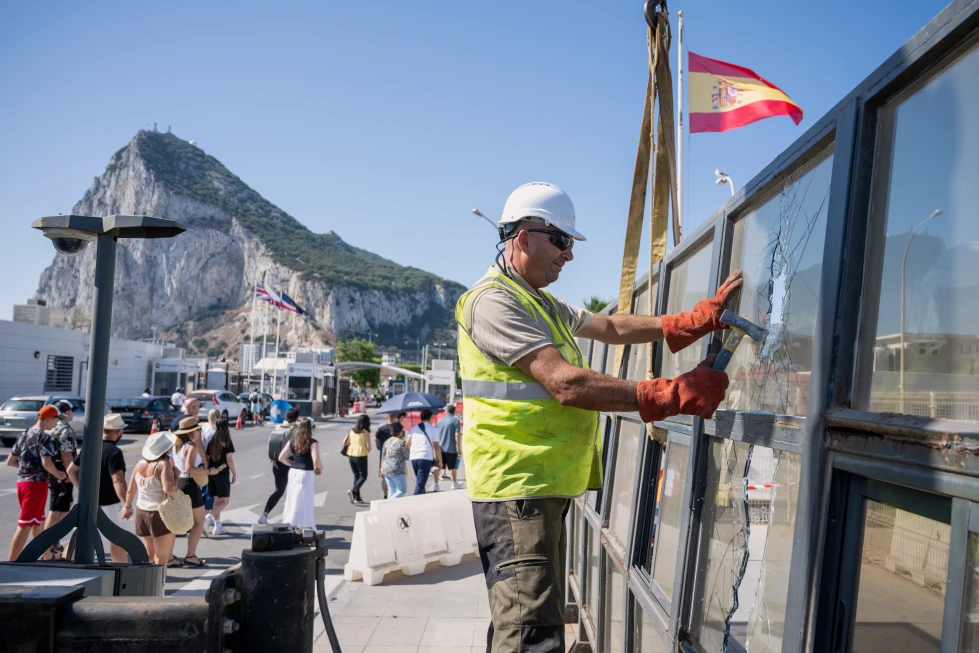
Under the agreement between the United Kingdom and the EU, the physical barriers on the land border with Spain have been removed and passport control at this crossing has been dropped. The treaty was signed on 14 July in Brussels and applies provisionally, with full ratification expected in the autumn. A breakdown of the text was published by the House of Commons Library. Gibraltar is not part of the Schengen Area, as confirmed by the UK Foreign Office. Immigration, policing and justice remain in the hands of the Gibraltar authorities.
Passport control now remains only at the airport and the port. There, Gibraltar officers admit travellers into Gibraltar and work alongside Spanish officers at a joint post; the Spanish side checks entry into the Schengen Area and registers arrivals in the EES, the EU's entry-exit system. At the land border, police are on duty with each side on its own territory - the Spanish on the La Línea side, the Gibraltar police together with customs, under the border measures. Documents are checked selectively, both when entering by car and when crossing on foot, and no stamps are given.
What the car hire companies charge for a trip into Gibraltar
Gibraltar is not part of Spain, so for a car hire company a trip there counts as travel to a third country. Some companies' hire agreements prohibit such a trip unless you declare it or pay the Cross Border fee, which extends the hire terms to cover Gibraltar. With Hertz this is a €30 charge plus a fine of up to €600 for an undeclared trip outside Spain; with Goldcar it is €15 a day for the whole hire period if Cross Border is not paid in advance. With Record Go, a breach voids all insurance cover.
Number plates are not recorded at the land crossing, but that has no bearing on your agreement with the car hire company - the terms for leaving the country must be agreed with them.
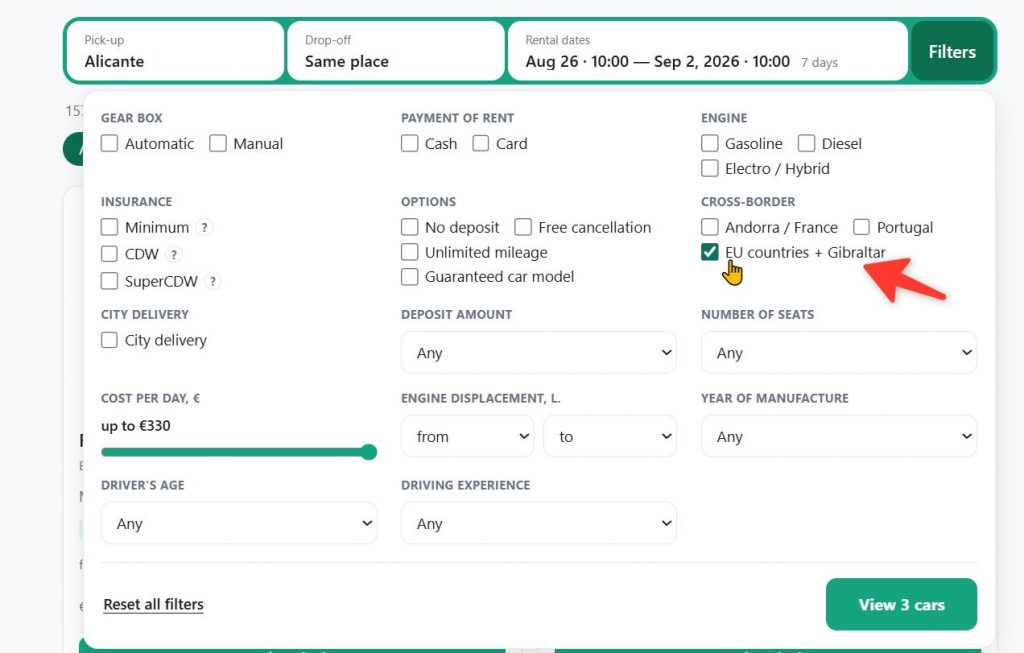
Our catalogue includes cars that come with the option of travelling anywhere in the European Union, including Gibraltar (even though Gibraltar itself is not part of the EU). To show these cars, select the "EU countries + Gibraltar" option in the filters, under the "Cross-border" filter group.
Customs on the way back into Spain
Customs at the border remain in place despite the removal of passport control. Gibraltar lies outside the EU customs territory, and the limits on returning to Spain are unchanged: 200 cigarettes or 250 g of tobacco, 1 L of spirits above 22% or 2 L of weaker drinks, 4 L of wine, 16 L of beer. The rules are set out on the Spanish tax agency website, and the Gibraltar import allowances on the government site. Tobacco and alcohol are cheaper in Gibraltar, and this is exactly what the Spanish side checks for on a selective basis.
Where to leave the hire car: in Spain or drive into Gibraltar
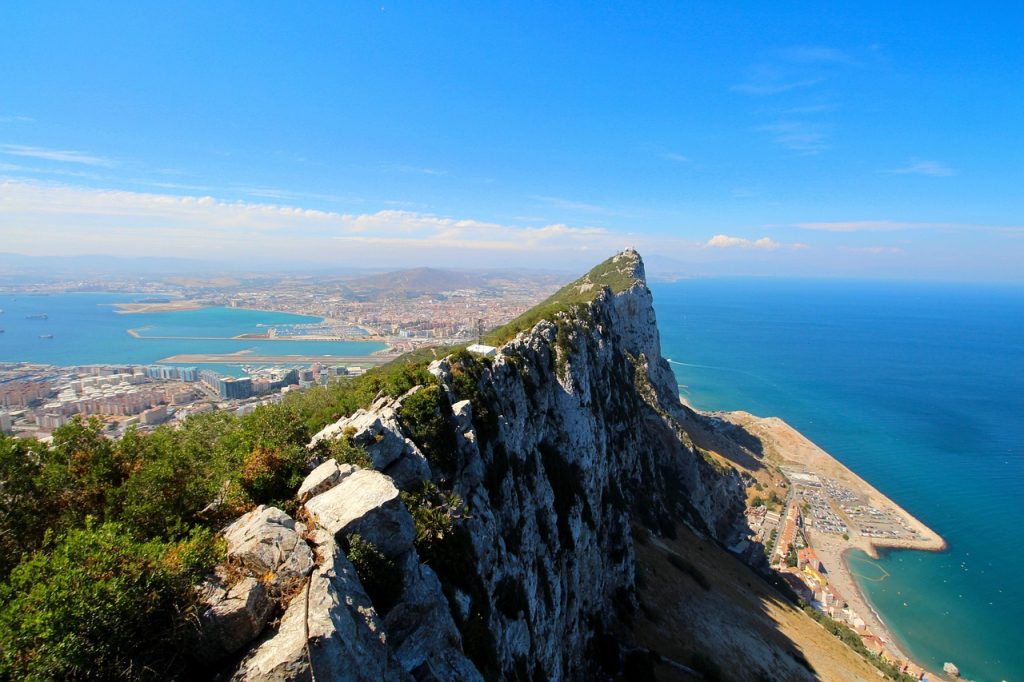
There is no need to drive into Gibraltar itself. Parking is scarce, traffic builds up at the crossing, and cars are not allowed up to the macaques on the Upper Rock in any case. Leave the car on the Spanish side in La Línea and cross the border on foot - it now takes a couple of minutes instead of the old queue. From the crossing it is another 15 minutes on foot to Main Street, or you can take a bus just across the border.
Car parks in Spanish La Línea
- Santa Barbara - Av. Principe de Asturias 6, an open lot with some spaces under cover, 690 spaces, fenced and open around the clock. The closest to the crossing, 2-5 minutes on foot. €12.50 for 6 hours.
- iPark Puerta de Gibraltar, also known as Focona - Av. Veinte de Abril 20, underground, with a 2 m height limit. Up to €16.50 a day, 3-4 minutes to the border.
- IC Plaza de la Constitucion - underground, €2.30 per hour, day rate €7-8. 5 minutes to the border.
- COPARK Alcaidesa Marina - Av. Principe de Asturias, covered, height up to 3.5 m, €9 a day. 10 minutes on foot to the border.
The blue-zone street parking (zona azul) near the border costs €1.30 for the first hour and climbs from there, reaching €6.35 for the maximum 6-hour stay. On Sundays parking is free with no time limit. For a single day this is cheaper than a car park, but the blue zone is no place to leave the car for the whole trip.
Rules of the road in Gibraltar
Traffic drives on the right, as in Spain and unlike the UK. The default limit is 50 km/h, with lower limits signed on some stretches. Speeds are marked in kilometres per hour, with no miles on the signs. Seat belts are compulsory in all seats, including the rear; dipped headlights are required after dark; and pedestrians have priority at crossings. There is no entry charge for crossing the border. The full list is published in the rules for drivers.
A non-resident's private car is not allowed into the Gibraltar Nature Reserve on the Upper Rock. The exception is for holders of a Blue Badge, the UK parking permit for drivers with disabilities. You reach the top by cable car, on a taxi or bus tour, or on foot. The nearest public transport stop is the terminus of route 1 by the Moorish Castle entrance.
Macaques come out onto the road - keep the windows shut
Barbary macaques live on the Upper Rock, the only wild primates in Europe. They are not afraid of people, climbing onto bonnets and through open windows to pull food and bags out of the car.
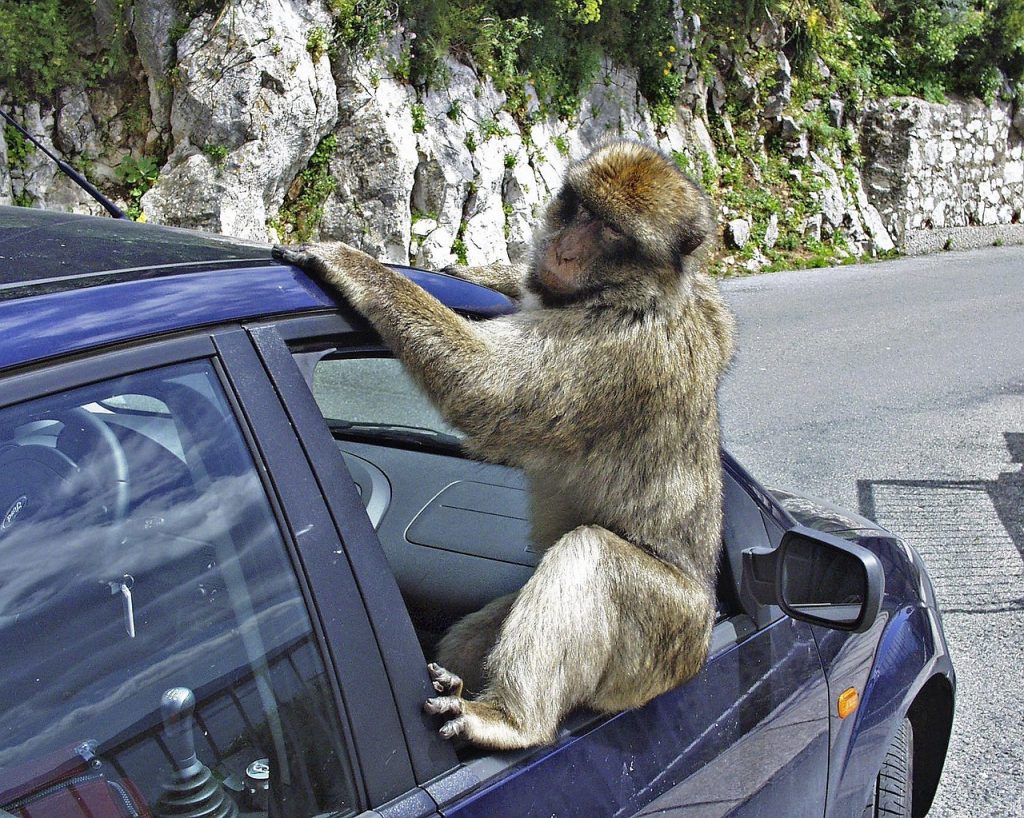 Inside the reserve, keep doors and windows shut and move bags and food off the seats and out of sight. Some groups come down into the town, so leaving the car with an open window is a bad idea at a town car park too.
On the reserve roads there is a triangular sign showing the silhouette of a monkey, with a SLOW plate beneath it. It means the animals come out onto the carriageway and you should slow down in good time.
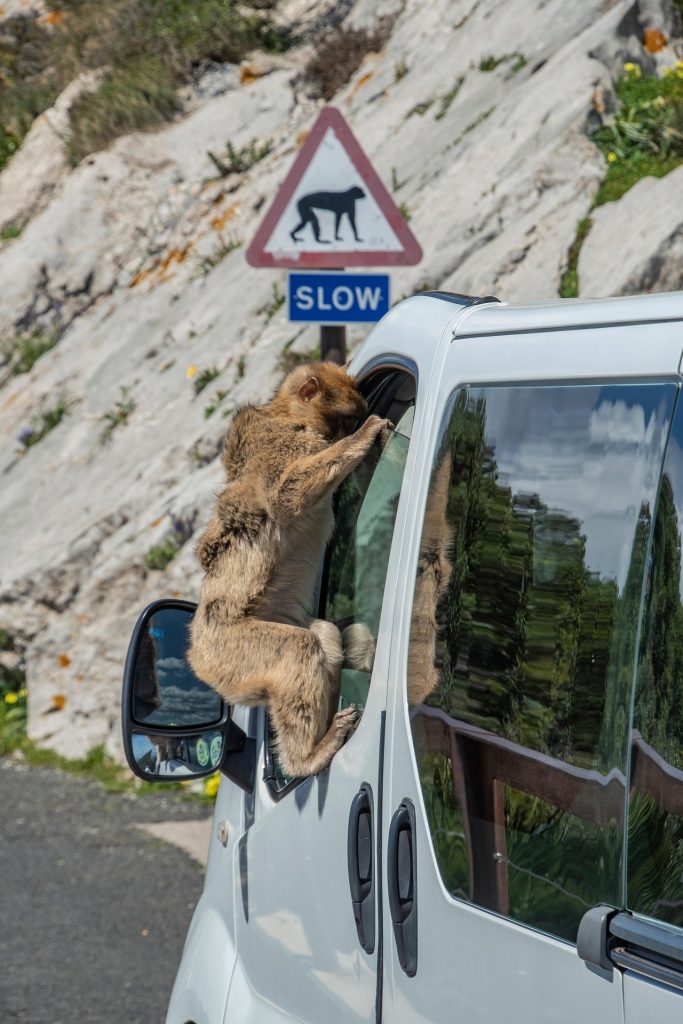 Feeding the macaques is prohibited by law, with a fine of £500, and touching them is also banned - the rules are published by the Government of Gibraltar.
The population is managed by GONHS and the Gibraltar veterinary service; the animals receive their own feed, and hand-feeding damages their digestion and their social structure.
Where to park in Gibraltar
The streets in the centre are narrow, there are only a few public car parks, and almost all of them are concentrated along Queensway and around Ocean Village.
- Grand Parade by the lower cable car station - the central bays with white markings are free, yellow markings are reserved for residents with a permit, and blue is the paid pay-and-display zone.
- Midtown on Queensway - a covered multi-storey, within walking distance of Main Street through the centre.
- ICC, also known as the International Commercial Centre - in the city centre, the closest to Main Street.
- Ocean Village under the Ocean Spa Plaza tower - more than 200 spaces, with toilets and a café-lined waterfront nearby.
Rates are quoted in pounds and vary from one car park to another, so check the rate on the machine or in the app. You can pay and extend your ticket remotely through Gibraltar Car Parks, the government-owned company that runs the town's car parks. You also pay any fine for overstaying through the same company.