
How to drive in Spain
Road signs and markings in Spain follow the Vienna Convention on Road Signs and Signals, so any European driver reads them without preparation.
Most fast roads are free. A few motorways with AP in their number are tolled, but you can almost always get round them on a free road instead.
In Spain speed limits and distances are given in kilometres. Traffic drives on the right.
On autopista and autovía motorways a car may do up to 120 km/h. That is the national maximum - nowhere is anything higher allowed.
On all other country roads the limit is 90 km/h. Spanish classification calls them carreteras convencionales - this takes in N-numbered national roads as well as regional and local roads.
In built-up areas the limit depends on the number of lanes. It is 50 km/h where there are two or more lanes in one direction, 30 km/h where there is a single lane, and 20 km/h on single-platform streets where the carriageway and pavement are at the same level. Where a sign is posted, the figure on the sign applies.
Speed cameras are uncommon on fast roads, but turn up in unexpected places - in empty fields and in the mountains.
Camera locations in Spain aren't hidden. Google Maps marks cameras and speed traps. DGT (Spain's traffic authority) also publishes fixed cameras on its infocar DGT map. In Catalonia and the Basque Country the cameras are run by regional services, and not all of them appear on the infocar map.
Key traffic rules in Spain
Drive on the right
Overtake in the left lane, give way to traffic already on a roundabout, and keep to the right on the motorway.
Speed limits
120 km/h on motorways, 90 on open roads, 50 in towns, 30 on narrow urban streets. The limit drops sharply as you enter a town.
Drink-driving
0.5 g/l of blood, or 0.3 for drivers with under two years' experience. Simplest not to drink at all before driving.
Mandatory kit
A reflective jacket within reach inside the car and a V16 beacon. Both should already be in the hire car - check.
Radar detectors are banned, GPS alerts are not. A device that picks up a police radar signal is illegal in Spain - a €500 fine, and the device is confiscated. A sat-nav or app that shows where fixed cameras are, though, is fine to use. DGT publishes camera locations openly anyway, and the same alert is in Google Maps.
A non-EU licence needs an International Driving Permit. An EU or EEA licence is enough on its own. From outside those, your national licence needs an International Driving Permit (IDP) or a sworn translation alongside it, depending on the country. Carry both your licence and your passport - they're checked at the hire desk and may be checked on the road. For what your particular licence needs, see the guide on driver requirements.
Overtaking a cyclist - at least 1.5 metres. When you pass a cyclist, leave at least 1.5 metres to the side. For that you may cross a solid line and even move into the oncoming lane if it's clear. On a narrow single-lane road this often means slowing down and waiting behind the cyclist - which is exactly what you should do.
New rule in 2026: the V16 beacon replaces the warning triangle
From 1 January 2026, Spanish-registered cars must carry a V16 beacon instead of the old warning triangles - a small yellow light you place on the roof without leaving the car. The beacon sends its coordinates to the DGT (traffic authority) system. The rule applies to every hire car on Spanish plates too.
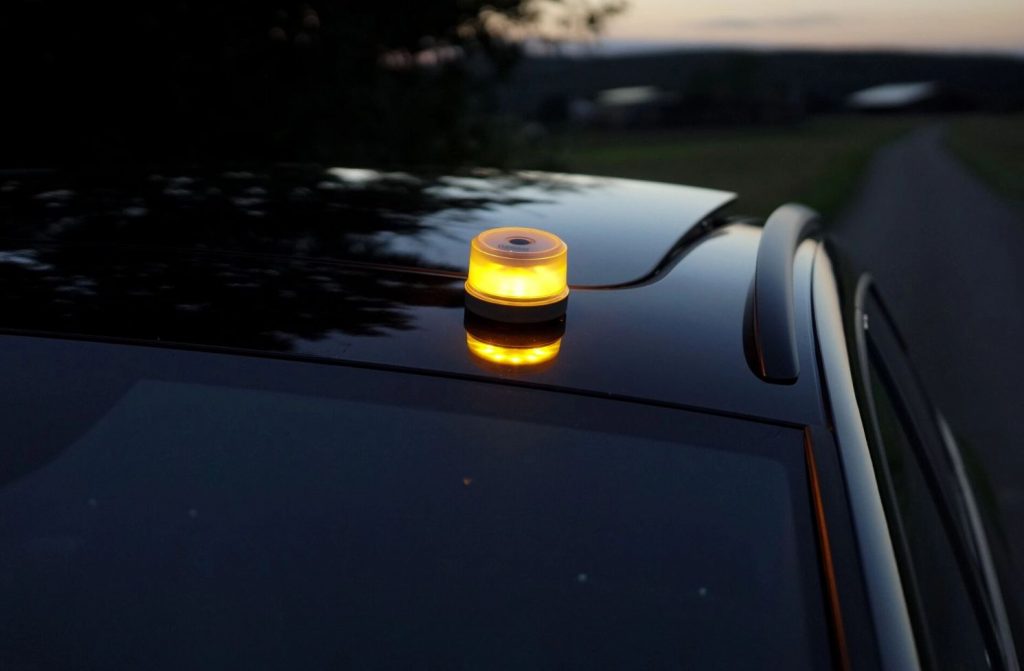
The V16 beacon (baliza V16) - a yellow magnetic light you place on the roof.
In an incident, the driver, not the hire company, is responsible for a missing or unplaced beacon. So when you collect the car, check the V16 beacon is there. Tourists on their own foreign plates may still use triangles, but that doesn't apply to cars hired in Spain
The beacon requirement was brought in because drivers previously had to get out of the vehicle to place a warning triangle far enough away. That created an extra risk, which the flashing beacons remove - they are required to be visible from up to one kilometre away and to stand out even in poor visibility such as fog, rain or darkness.
Everyone in the car needs a seatbelt - the driver and rear passengers alike. Not wearing one is a €200 fine, charged to each person separately. Children under 135 cm must travel in a child seat or booster matched to their height. Penalty points for this apply only to EU licences - a tourist on a different licence is just left with the fine. More on the DGT site.
Holding a phone at the wheel is completely forbidden. That's €200 and 6 points off (for EU licences), and you're fined even when stopped at a red light or in a queue. Touching the screen of a phone in a holder to change your route counts the same. Only hands-free calls and voice commands are allowed, without touching the screen.
DGT environmental stickers and ZBE zones
Spanish cities have areas with restricted access. They're called ZBE, in Spanish zona de bajas emisiones, low-emission zone. Access depends on the car's environmental category, and that category depends on the fuel and the date the car was first registered.
The category is assigned by the DGT, Dirección General de Tráfico - Spain's traffic authority. It's shown by a coloured sticker on the windscreen, in Spanish distintivo ambiental.
The sticker only shows the emission level. You don't pay to drive on it - toll motorways have barriers and booths, and those have nothing to do with the environmental category.
The four categories
| Sticker | Colour | Which cars |
|---|---|---|
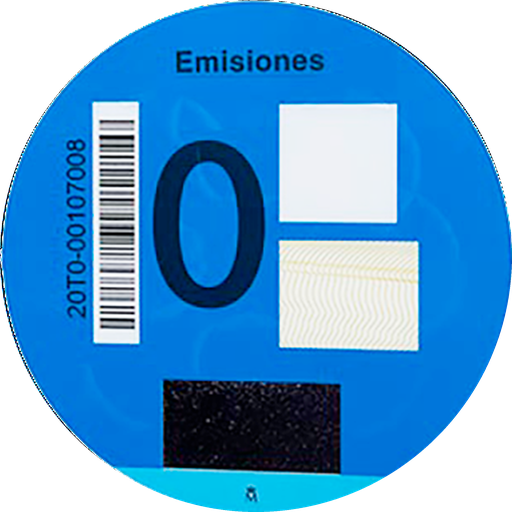 0 0 |
blue | electric cars, hydrogen cars and plug-in hybrids with an electric range of 40 km or more |
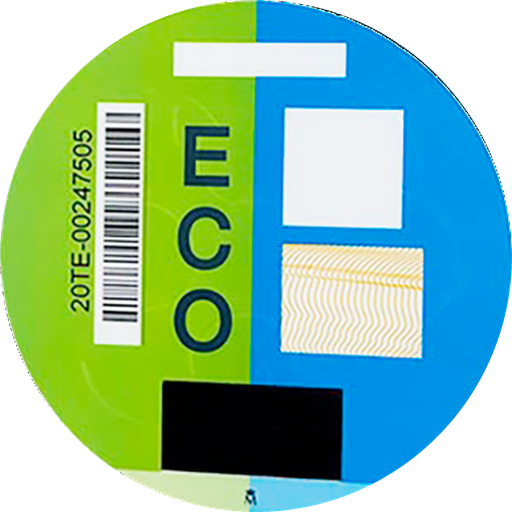 ECO ECO |
blue-green | hybrids with an electric range under 40 km, and vehicles running on GLP and GNC gas |
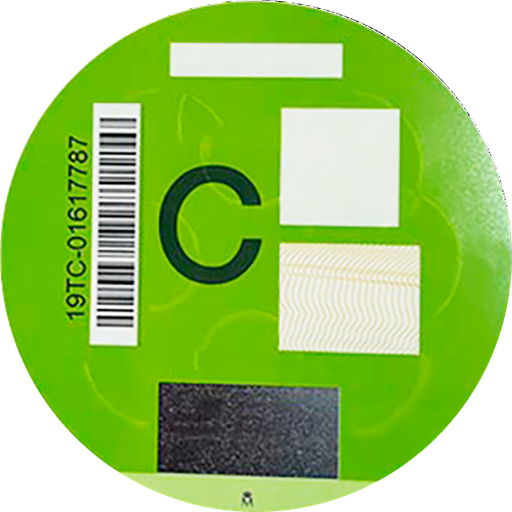 C C |
green | petrol cars registered from January 2006, and diesels from September 2015 |
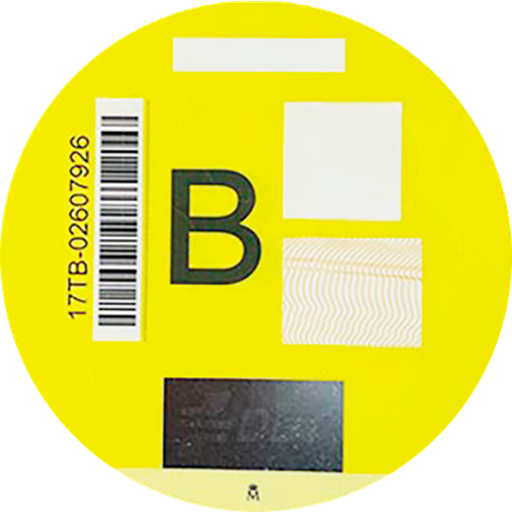 B B |
yellow | petrol cars from 1 January 2001 and diesels from 2006 |
GLP and GNC are the Spanish abbreviations for two types of gas fuel. GLP is propane-butane, written LPG or autogas in most countries. GNC is methane, CNG outside Spain. You'll see both abbreviations in the car description and on the pump.
The lower the emissions, the higher the category and the freer the access. Cars with 0 and ECO are let in almost everywhere; for C and B, some zones set their own conditions.
Cars with no sticker
Petrol cars older than 2001 and diesels older than 2006 get no sticker at all. In most cities the ZBE ban applies only to them.
There are no such cars in the hire fleet, so this restriction won't affect you. A hire car has at least a C, a hybrid an ECO.
How the category is checked
The sticker goes in the bottom right corner of the windscreen. But it isn't what's checked - at the zone entrance a camera reads the number plate and matches it against the DGT database. You can look up the category of any Spanish plate yourself, on the DGT site.
A car on foreign plates isn't issued a Spanish sticker, and doesn't need one. That doesn't apply to a hire car - it's on Spanish plates.
Madrid's rules are stricter
Inside Madrid's overall ZBE there are two specially protected zones, Distrito Centro and Plaza Elíptica. In Spanish they're called ZBEDEP, zona de bajas emisiones de especial protección.
Their entry conditions are separate, and a C sticker isn't always enough for them.
Petrol stations and charging points
At the pump in Spain, petrol is labelled gasolina and diesel is diésel or gasóleo A. There are two kinds of station, and the price difference is noticeable.
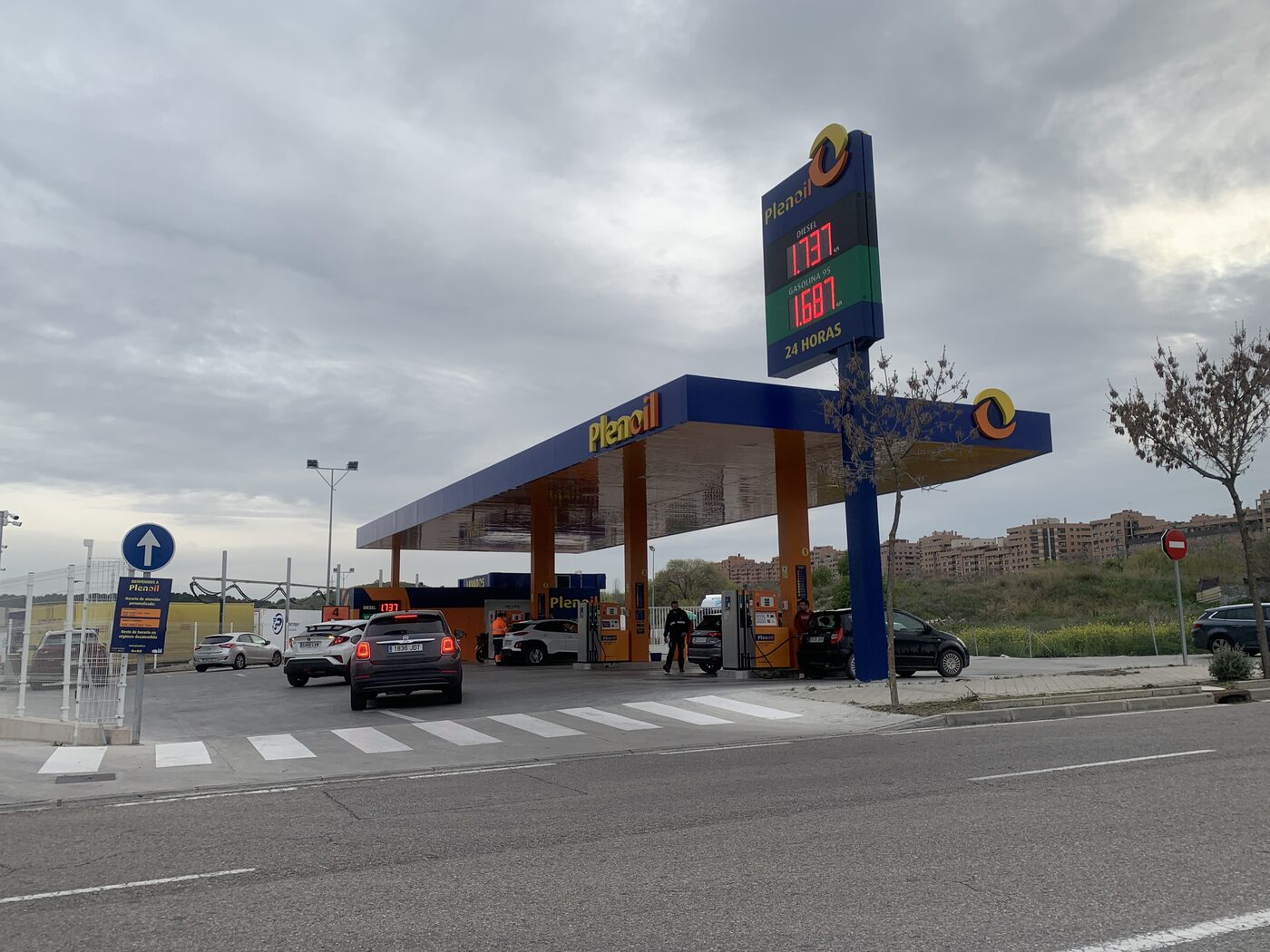
Self-service station: you fill up yourself and pay at the terminal on the pump. Photo: Natalia Corcobado Pinilla / Wikimedia Commons, CC BY-SA 4.0
Self-service stations (autoservicio) have no staff - you fill up yourself and pay by card at the terminal on the pump. A litre here is 5-15 cents cheaper, and many are open around the clock. Big chains of these are Plenoil, Ballenoil and Petroprix.
Branded stations with a till - Repsol, Cepsa, BP, Galp - cost a little more. In return there's a shop and a small café inside, with coffee, pastries and a toilet. The fuel itself is the same quality, checked against a single European standard - the extra pays for the service, not for better petrol.
Large stations along the motorways often have a rest area and a separate building with a bigger café or restaurant - hot meals there, not just pastries off the shelf.
Which fuel to put in
Since 2018 every pump in the EU uses the same symbols: petrol in a circle, diesel in a square. What you'll see in Spain:
- Gasolina 95 E5 and Gasolina 98 - petrol. The number is the octane rating, so 98 is more powerful and dearer; E5 means up to 5% ethanol. A petrol hire car takes 95 unless the contract says otherwise.
- Gasóleo A (the B7 symbol) - ordinary diesel for cars, up to 7% biodiesel.
- Gasóleo B - red agricultural diesel for tractors and boats. It's cheaper, but putting it in an ordinary car is banned: a fine of €600 to €12,000, and the car can be impounded. Car stations usually don't stock it anyway.
- Premium (Repsol Efitec, Cepsa Óptima, BP Ultimate) - the same 95 or 98 with additives, dearer. A hire car doesn't need it.
The same symbol - 95, E5 or B7 - is on the fuel flap or next to the filler neck. Check there before your first fill-up so you don't mix up petrol and diesel: putting in the wrong fuel is an expensive mistake.
Apps with fuel prices
Spain's government collects prices from every station - each is required to report them to a shared database, so the prices in the apps are real, not advertising.
- Geoportal Gasolineras - the official government site, plus the Ruta-E app (iOS and Android): a map, a fuel filter, real-time prices and charging points as well.
- Gasofa - a free app on the same data, handy for finding a cheap station along your route.
- Waze - a sat-nav that colour-codes stations by price right on the map.
Charging an electric car
Hired an electric car? Plan your route around the chargers in advance. In the south and in cities there are plenty, but between smaller towns the network is still thinner than ordinary petrol stations. Chargers vary in power, and the time depends on it:
- Slow, alternating current (AC), 3.7-22 kW - on streets, at hotels and in supermarkets. A full charge takes several hours, so they suit leaving the car for a long stint.
- Fast, direct current (DC), 50 kW - at petrol stations and by the road. To 80% in about 40-60 minutes.
- Ultra-fast (DC), 150-350 kW - on the motorways for long trips. To 80% in 15-30 minutes, if the car can take that power.
How to choose: for a long drive, the ultra-fast ones on the motorway; overnight at the hotel or while you're round the shop, the slow ones. The real speed comes down to what the car itself accepts: many take 50-150 kW at most, and a more powerful charger won't charge them any faster.
Points and prices are easier to check in aggregator apps: Electromaps and the official Ruta-E see every network's chargers at once. The big networks have their own apps too: Iberdrola (the largest network), Endesa X Way, Zunder, Wenea and Ionity (ultra-fast on the motorways). You usually start a charge from the network's app, and pay there too.
Charging at supermarkets
You can also charge while you're doing the shopping. Mercadona has around 5,000 points: some free for 60 minutes at 3.7 kW, some paid at 22 kW for €0.25 per kWh - paid through the Iberdrola or Repsol Waylet apps. Consum has more than 800 chargers from 22 to 150 kW, started through the Eranovum app.
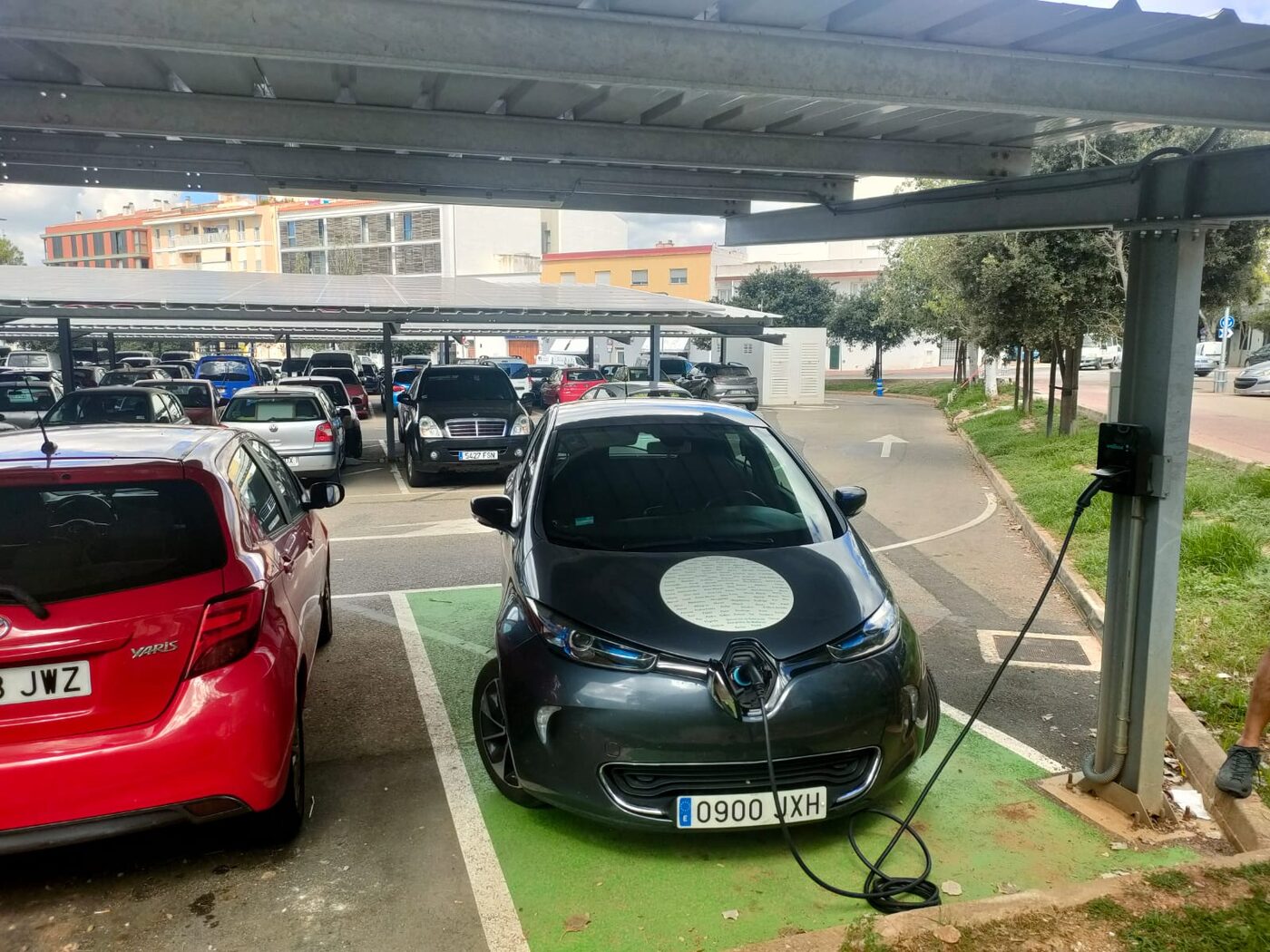
Charging in a car park under a solar canopy. Photo: Chixoy / Wikimedia Commons, CC BY-SA 4.0
Rest areas on the motorways
On autopistas and autovías, roughly every two hours of driving there's an area you can pull off into and stop.
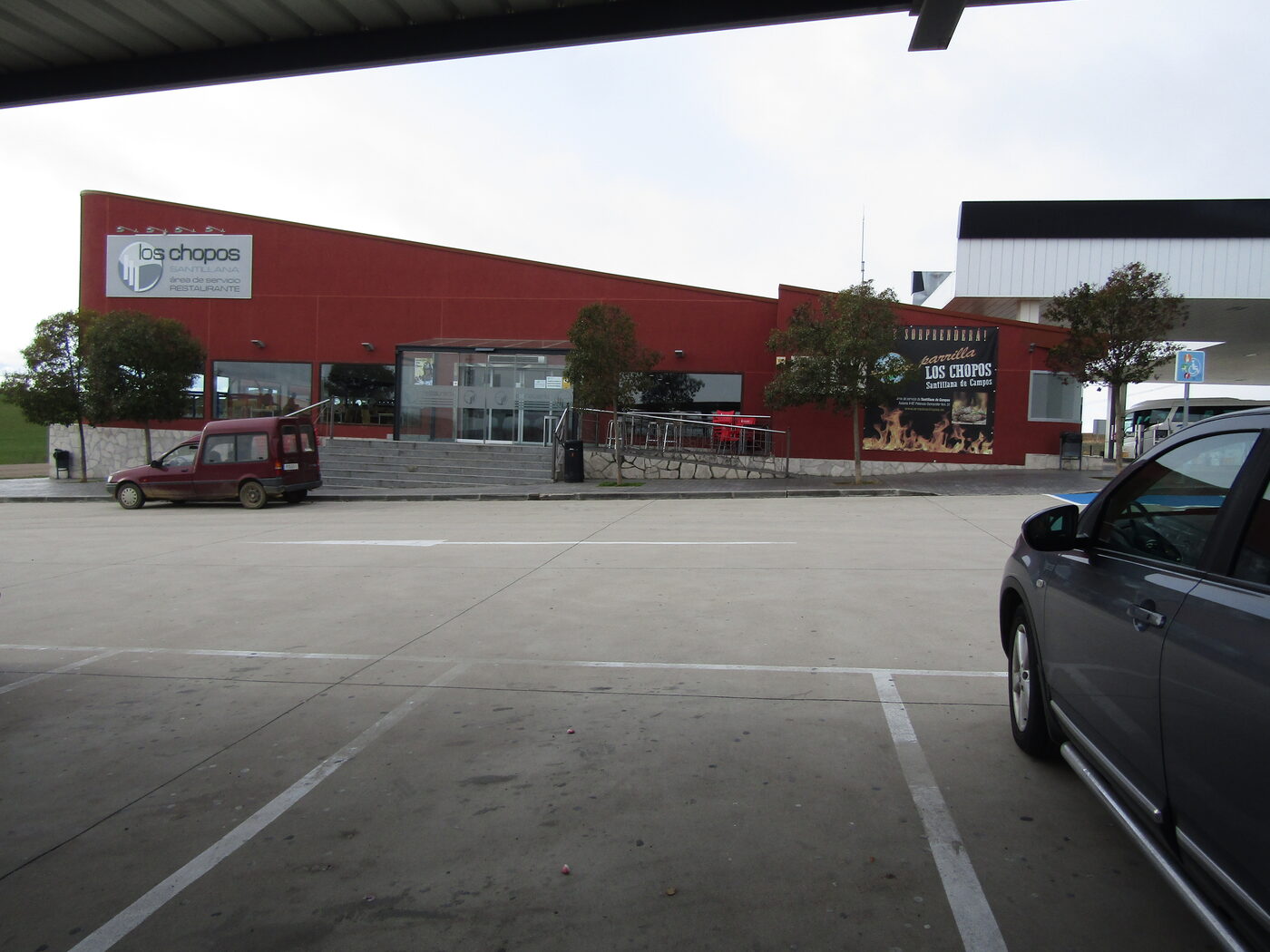
Área de servicio - with a restaurant, a shop and a large car park. Photo: Kolforn / Wikimedia Commons, CC BY-SA 4.0
There are two kinds. An área de servicio has a petrol station, a shop, a café or restaurant, a toilet and a large car park; you pull off here to fuel up and eat. An área de descanso is simpler - just a car park, tables and a toilet, with no fuel or food.
A blue sign with a fork, a bed or a fuel pump tells you what the next area has. You can't just stop on the motorway hard shoulder to rest - the shoulder is only for emergency stops. Tired at the wheel? Make it to the nearest area and stop there.
Parking in Spain
On-street parking is marked by colour, and the colour of the line on the tarmac matters more than the sign.
- White lines, or no markings at all - parking is free with no time limit.
- Blue - a paid zone. Pay at the parquímetro machine on the pavement and put the ticket under the windscreen, printed side up.
- Green - spaces for local residents. In some cities a visitor can park for an hour or two at a higher rate, in others not at all.
- Yellow - no parking; your car gets towed away.
In the historic centre there are almost no free white spaces - count on an underground car park. It's marked by a blue letter P, paid on exit by the actual time used.
Parking apps
In a blue zone you needn't hunt for a coin machine - you pay from your phone, and if you run over, you extend the time in the app. easyPark and Telpark work across the country. Free and paid parking, underground included, is shown by Parkopedia and plain Google Maps. Madrid and Barcelona have their own city apps, but it's simpler for a visitor to install one universal one.
Supermarket car parks
The Mercadona, Consum, Carrefour and Lidl chains have their own car parks, and they're free. Each store sets its own terms. At some you can leave the car for any length of time and without shopping; at others free exit is tied to a receipt - sometimes any receipt, sometimes a purchase of €10 or more. The rules are written on a sign at the entrance; read it straight away.
If a barrier gives you a ticket on the way in, keep it. At the till they ask for the ticket to validate free exit. Without validation the exit barrier won't open.
Fines
A fine reaches a tourist in one of two ways - on the spot on the road, or later through the hire company.
People living in Spain don't pay on the spot - they get a notice and can pay later, with the amount halved in the first 20 days. It's stricter for a tourist: if you're stopped on the road and have no address in Spain, the officer may demand payment or a deposit there and then. Don't pay and don't leave a deposit, and the car can be held until you do.
A camera fine or an unpaid toll comes later - and not to you but to the hire company. The company charges your card the amount of the fine plus its own processing fee (usually 1-10%). If the car was taken without a credit card and without a deposit, the company passes your details to the traffic authority, and the fine is posted to your home address.
Watch your speed as you enter a built-up area. The limit drops from 90 or 100 to 50 km/h, and on streets with a single lane each way, down to 30 km/h.
Checklist when you collect the car
- V16 beacon - connected, approved, present in the car.
- Reflective jacket - in the cabin, not in the boot.
- DGT environmental sticker - on the windscreen for low-emission zones.
- Fuel type - check whether it's petrol or diesel before your first fill-up.
- Visible damage - photograph it and check it's all noted in the contract.